
Treasure Party: Puzzle Fun!
PlayQ IncPuzzle
4.62.37K Reviews
- Version
- 3.26.0
- Installs
- 1.00M
- Age Rating
- Everyone
Screenshots
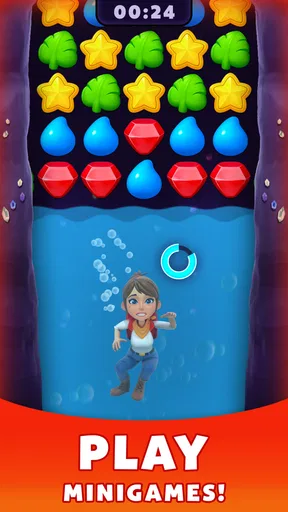
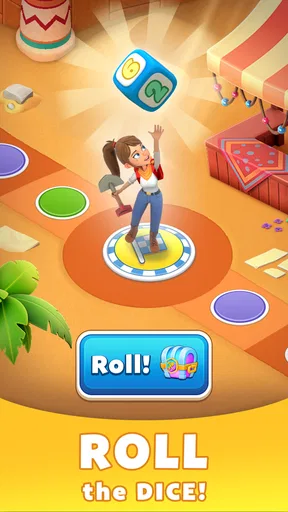
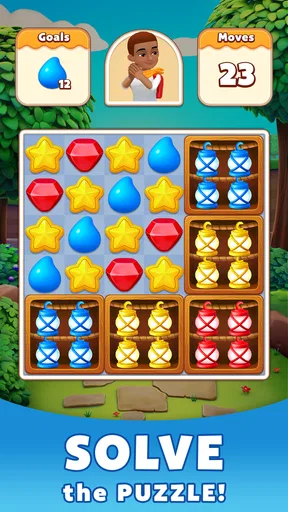



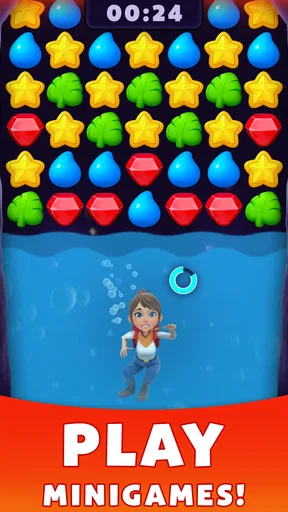
Our Review of Treasure Party: Puzzle Fun!
 Analysis by Appyee
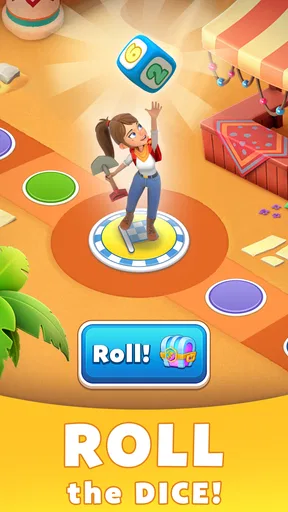
I approached Treasure Party: Puzzle Fun! as a light puzzle game rather than something designed for long, demanding sessions. Its basic appeal is easy to understand: you roll dice, match tiles, and move through a playful adventure that mixes short puzzle moments with mini-games. That combination makes it a natural candidate for a quick break, especially when I want more variety than a traditional match-three board.
The important thing is to set the right expectation. This is not a quiet, purely strategic puzzle board where every minute is spent planning the perfect move. The dice and mini-game elements give it a more casual, changeable rhythm. Sometimes that is exactly what makes it enjoyable; at other times, players who want deep control may find the experience less focused. I found the game most appealing when I treated it as a compact entertainment loop instead of a serious brain-training tool.
What playing it feels like in everyday use
PlayQ Inc is the developer behind this free puzzle game, which is aimed at Everyone and belongs to the casual puzzle side of mobile gaming. It has reached over a million installs and holds a 4.6 average from around 102 thousand ratings, so there is clearly a broad audience for its mix of board-style progress and quick challenges. Those figures do not change the personal experience, but they do suggest that the game has found a comfortable place among accessible mobile puzzlers.
My first impression was that the format is easy to approach. Rolling dice gives each session a sense of movement, while matching tiles provides the familiar part of the puzzle formula. The mini-games help prevent the routine from feeling completely flat. I did not need to study a complicated rulebook before understanding the basic objective, which is valuable when the game is being opened for a few minutes between other tasks.
A realistic use case is a short commute, a waiting room, or the final few minutes before bed when I want something interactive but not mentally exhausting. The game suits players who enjoy seeing progress in small portions. I can finish a brief stretch of play, put the phone away, and return later without needing to remember a complicated plot or a long chain of strategic decisions.
That convenience comes with a trade-off. The random feel of dice-based movement can make progress feel less fully controlled than it would in a conventional tile puzzle. If I am looking for a game where skill alone determines every outcome, I would choose a more focused logic title instead. Here, the pleasure comes from the combination of familiar matching, chance, and changing activities.
Where new players may get stuck
The first likely point of friction is understanding how the different parts fit together. A player who expects only tile matching may initially wonder why dice rolls and mini-games are part of the same experience. I found it helpful to think of the tile board as one layer of the game and the dice-driven adventure as the wider structure around it. That mental model makes the changes in pace feel intentional rather than distracting.
Another possible sticking point is the difference between a good move and a merely available move. In a standard matching game, I often look for the largest immediate combination. In this title, I would slow down and consider whether a move helps the current board position or simply clears space. When the board becomes crowded, creating room can be more useful than chasing a small match that looks attractive at first.
Mini-games can also interrupt a player’s preferred rhythm. I generally enjoy the variety, but someone who downloaded the game specifically for matching tiles may regard those changes as a detour. The reverse is also true: a player hoping for constant mini-game action may find the tile sections slower. The game works best for people who genuinely accept both sides of its design.
One practical habit helped me avoid frustration: I did not treat every failed attempt as a sign that the game was malfunctioning. A poor board position, an unlucky roll, or a rushed decision can all produce an unsatisfying result. Before restarting repeatedly, I would look at whether the problem came from the current puzzle state or from the app itself.
Setup checks before blaming the game
The current version is 3.26.0 and the minimum operating system is Android 7.0. That makes compatibility relatively approachable for older Android devices, although compatibility on paper is not the same as a smooth session on every phone. Before installing, I would check that the device has enough free storage for the download and its working space, then close demanding apps if the phone is already struggling.
Because this is a free game with optional in-app purchases ranging from $0.99 to $149.99 per item, I would also review purchase controls before handing the device to a child. The Everyone age rating makes the game broadly accessible, but an age rating does not replace sensible account and payment settings. A quick check of the device’s purchase authentication can prevent an accidental transaction during an otherwise harmless play session.
If installation pauses, I would begin with ordinary checks rather than repeatedly tapping the install button. A stable connection, available storage, and a current store session are sensible first steps. If the download appears stuck, pausing and resuming once can be more useful than leaving several attempts running at the same time. Restarting the device is also a simple way to clear a temporary store or memory problem.
For a player moving from another phone, I would avoid assuming that progress will automatically appear just because the game has been installed again. The safest approach is to use whatever sign-in or recovery option the game presents, if one is available, and to make sure the same device account or game account is being used. I would not uninstall the original copy until I was satisfied that important progress is accessible on the new device.
These checks are not glamorous, but they matter with casual games because the expectation is instant access. If the game opens normally after installation but later behaves strangely, the issue may be temporary device pressure rather than a flaw in the puzzle design. Keeping the operating system current where possible and leaving some storage free gives the game a better chance of starting and switching between its activities cleanly.
Recovering a disrupted play session
When a session stops responding, I would first give the game a moment rather than immediately pressing several controls. Rapid taps can make it harder to tell whether the screen is delayed or whether the input was ignored. If the screen remains frozen, closing the game completely and reopening it is the most sensible first recovery step.
If the problem returns, I would separate the symptoms. A crash during launch points toward setup, memory, or compatibility. A problem that appears only while connected may relate to the connection or a temporary service issue. A single puzzle that feels impossible is not automatically a technical fault; it may simply be an unfavorable board or an awkward sequence of choices.
For a missing reward or interrupted transition, I would avoid making the same purchase or action again immediately. First, I would reopen the game and check whether the state has caught up. If the result still looks wrong, recording the exact sequence of events is more useful than sending a vague complaint. The useful details would be the device, operating system, what screen was open, and whether the app closed, froze, or returned to the previous screen.
Clearing app data is a much more serious step than clearing temporary files, and I would not use it casually. It can remove local information or force a fresh setup, depending on how the game stores progress. I would only consider it after trying a normal restart and after confirming that progress can be recovered. The same caution applies to uninstalling: it may solve a damaged installation, but it can also create a new problem if local progress has not been linked or restored.
One useful workflow is to change only one thing at a time. Restart the app, test it, then consider the connection, and only later move toward reinstalling. If several settings are changed together, it becomes impossible to know which action helped. This approach is especially worthwhile for a game like this because most sessions are short, so a few careful checks are less disruptive than losing track of progress.
When the app may not be the cause
Not every interruption comes from Treasure Party itself. A phone with low free storage, aggressive battery management, or many background apps can close a game even when the game is behaving normally. Older hardware may also struggle more when a title moves between board play, dice-driven progress, and mini-games. If other apps are also freezing or closing, I would investigate the phone before judging this one.
Connection issues can be equally misleading. If the game starts but a transition takes longer than expected, I would test another reliable connection before repeatedly restarting. A weak signal can make a normal loading delay look like a broken feature. I would also avoid testing during a moment when the device is switching between mobile data and Wi-Fi, since that change can interrupt any game that needs to refresh its state.
There is also a human cause: playing while distracted. I noticed that the casual presentation can encourage quick tapping, especially when a board or mini-game changes pace. That can lead to missed information and mistaken assumptions about what the game asked me to do. Slowing down for a second before confirming a move is a small adjustment, but it makes the experience feel more deliberate and reduces avoidable errors.
Notifications and interruptions can create another confusing situation. A call, message, or system prompt may pull the game into the background at an awkward moment. If the app returns to a different screen, I would check the current state before repeating the previous action. The safest response is to let the game finish restoring itself rather than tapping through every visible button.
Players should also be realistic about the role of chance. Dice-based progress naturally produces outcomes that cannot be planned with complete certainty. That is part of the design, not necessarily evidence that the game ignored a successful move. For users who dislike randomness, a pure logic puzzle or a traditional match-three game may provide a more satisfying sense of control.
How it compares with familiar puzzle alternatives
Compared with a standard match-three game, this title offers a wider loop. Matching tiles remains recognizable, but the dice and mini-games give the session a more adventurous shape. I would choose it over a basic board when I want the activity to change occasionally. I would choose the basic board instead when I want to concentrate on one system without interruptions or extra layers.
Compared with a pure logic puzzle, Treasure Party is more relaxed and less demanding. It is better for casual entertainment than for players seeking carefully constructed deduction problems. There is value in that lighter approach: I can play without preparing myself for a difficult challenge. The downside is that a serious puzzle fan may find the mixture less intellectually rewarding than a game built around logic alone.
Compared with an offline-first puzzle, the practical experience may depend more on the condition of the phone and connection at the moment of play. I would keep that in mind if I needed something dependable during travel or in places with unreliable service. For those situations, a simple offline alternative may be the safer choice, while this game is more comfortable as an everyday casual option on a normally connected device.
The free entry point also makes it easy to try without committing money at the start. Still, the presence of optional purchases means I would decide in advance whether I am comfortable spending on convenience or progression. Players who prefer a completely fixed-cost experience should look for a paid puzzle with no purchase layer. Those who are happy to play for free while ignoring optional spending can approach this one with clearer boundaries.
Who should play it, and who should skip it
I would recommend it to someone who likes colorful casual puzzles, enjoys short sessions, and does not mind a little unpredictability. It is particularly suitable for players who want more variety than a single matching board but do not want the complexity of a large role-playing game. The Everyone rating also makes it a broadly approachable choice, provided purchase settings are handled responsibly.
I would be more cautious recommending it to a player who wants uninterrupted strategic depth. If your ideal puzzle gives you complete control, rewards long planning, and never changes its rules, the dice and mini-game structure may feel too loose. I would also steer away from it for anyone who becomes frustrated by chance-based progress or who wants a game that works as a guaranteed offline distraction.
For families, I would treat it as a game to play with sensible device controls rather than as something that needs no supervision simply because it is suitable for Everyone. The free download lowers the barrier to trying it, while the optional purchase range makes account protection worthwhile. A child can enjoy the matching and adventure elements, but the adult managing the device should still decide whether purchases are allowed.
For adults, the strongest use case is the flexible break. I can play a little, stop, and return without turning the game into a major project. It is less suitable when I am already tired of random rewards, repeated attempts, or switching between activities. The right choice depends less on the game’s broad puzzle label and more on whether its mixed rhythm matches the way I like to relax.
My practical verdict
Treasure Party: Puzzle Fun! succeeds because it combines familiar tile matching with dice-led movement and mini-games instead of asking one mechanic to carry the entire experience. I enjoyed it most when I wanted a friendly, low-pressure puzzle adventure that could fit into spare minutes. The design is approachable, and the large audience reflected by its rating and install figures is understandable.
My main reservation is the same feature that gives it personality: the mixed structure. Players who want a pure matching game may find the adventure layer distracting, while players who demand complete strategic control may dislike the influence of dice. The purchase options also deserve attention, not because they prevent free play, but because they make it important to set personal spending limits before settling into the game.
If the app fails to open or a session is interrupted, I would start with storage, connection, background activity, and a clean restart before assuming the puzzle itself is responsible. I would protect progress before reinstalling, avoid repeating purchases during a delayed update, and change troubleshooting steps one at a time. Those habits make the occasional technical or setup friction easier to manage.
Overall, I see this as a good fit for casual puzzle fans who want variety and a little chance mixed into their progress. I would download it for short, relaxed sessions and recommend it to a friend with that expectation. It is at its best as a flexible puzzle break, not as a substitute for a deep logic game or a guaranteed offline tool. With that distinction clear, the free starting point makes it worth trying for Android users running Android 7.0 or later.
Verdict
Strengths of Treasure Party: Puzzle Fun!
- Colorful graphics and playful animations make each level feel lively.
- Short stages are convenient for quick gaming sessions.
- Regular events add variety beyond the standard puzzle progression.
- Simple controls make the game approachable for younger players.
- Collectible rewards provide extra motivation to keep completing levels.
Limitations of Treasure Party: Puzzle Fun!
- Some later puzzles can feel heavily dependent on luck.
- Limited moves may make failed attempts frustrating.
- Energy or waiting systems can interrupt longer play sessions.
- Frequent rewards and pop-ups may feel distracting to some players.
- The core gameplay may become repetitive after extended play.
Other Releases by PlayQ Inc
View All
Charm King
Puzzle4.2
Similar Picks in This Category
View All
Block Blast!
HungryStudio4.8

Braindom: Brain Games Test
Lahana Game Studio4.6

AMAZE!
CrazyLabs LTD4.6

Sudoku - Classic Sudoku Puzzle
Oakever Games4.7

Art Puzzle - Puzzle Games
Easybrain4.8

Amaze GO!
Oakever Games4.9
Frequently Asked Questions
What is Treasure Party: Puzzle Fun!?
Treasure Party: Puzzle Fun! is a casual mobile game that combines board-game movement with short puzzle challenges. You guide characters through colorful treasure-hunting adventures, collect rewards, and unlock new areas as you progress. Its gameplay is designed for quick sessions, making it suitable for players who enjoy light strategy, mini-games, collection systems, and a playful adventure theme rather than a complex role-playing experience.
How does the gameplay work in Treasure Party: Puzzle Fun!?
The main progression revolves around moving through adventure stages, gathering resources, and completing puzzle-based activities. Depending on the level, you may need to solve matching challenges, overcome obstacles, or make quick decisions to continue exploring. Successful actions usually provide coins, items, or other rewards that help improve your progress. The controls are generally simple, although later challenges can require more careful planning.
Is Treasure Party: Puzzle Fun! free to download and play?
Treasure Party: Puzzle Fun! can generally be downloaded and played without an initial purchase, but it may include optional in-app purchases. These purchases can provide extra resources, special items, or faster progression. Players who prefer not to spend money can still enjoy the core experience, although they may encounter waiting periods, limited attempts, or slower access to certain rewards. Check the store listing for current pricing and availability.
Does Treasure Party: Puzzle Fun! require an internet connection?
An internet connection may be needed for some features, including loading advertisements, synchronizing progress, receiving events, downloading additional content, or using promotional rewards. Basic gameplay may work in certain situations without a stable connection, but offline availability can vary by device and game version. For the most reliable experience, especially when saving progress or claiming rewards, it is best to play while connected to Wi-Fi or mobile data.
Is Treasure Party: Puzzle Fun! suitable for children?
Treasure Party: Puzzle Fun! uses bright visuals, simple controls, and accessible puzzle mechanics that can appeal to younger players. However, parents should review the age rating, advertising practices, privacy information, and available in-app purchases before allowing children to play. If the game is used on a shared device, parental controls are recommended to prevent accidental purchases and to manage screen time. The appropriate age may also depend on the child’s ability to handle competitive or timed challenges.
Play our best games!


